Marzuki’s Violin
Introductory Talk & The Bang Maing Workshop Writing Veiled Lyrics and Collective Solidarity
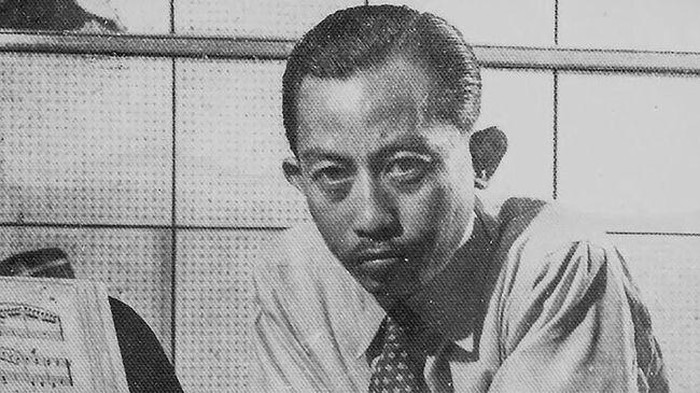
Ismail Marzuki © Wikimedia Commons
Length: 02 hours 00 minutes
Language: English
Participant Capacity: Introductory talk open to the public, workshop for 5–10 participants (intimate/lab format)
Target Audience: Writers, musicians, visual artists, activists, students, or anyone interested in creative writing, cultural resistance, and sociopolitical commentary. No prior songwriting experience is required. Participants are expected to bring their own writing tools (pen/notebook) and an open mind for collective brainstorming.
Free entry
Marzuki’s Violin is a collaboration between Gudskul Ekosistem and Paola Pietronave which was born from their shared interest in creating a film about Ismail Marzuki, an Indonesian composer, songwriter, and musician as well as a renowned national hero in the struggle for independence. The project will be presented for the first time at the Biennale Matter of Art in the form of an introductory talk and workshop coordinated by Berto Tukan, JJ Adibrata, Moch Hasrul Indrabakti, and Paola Pietronave.
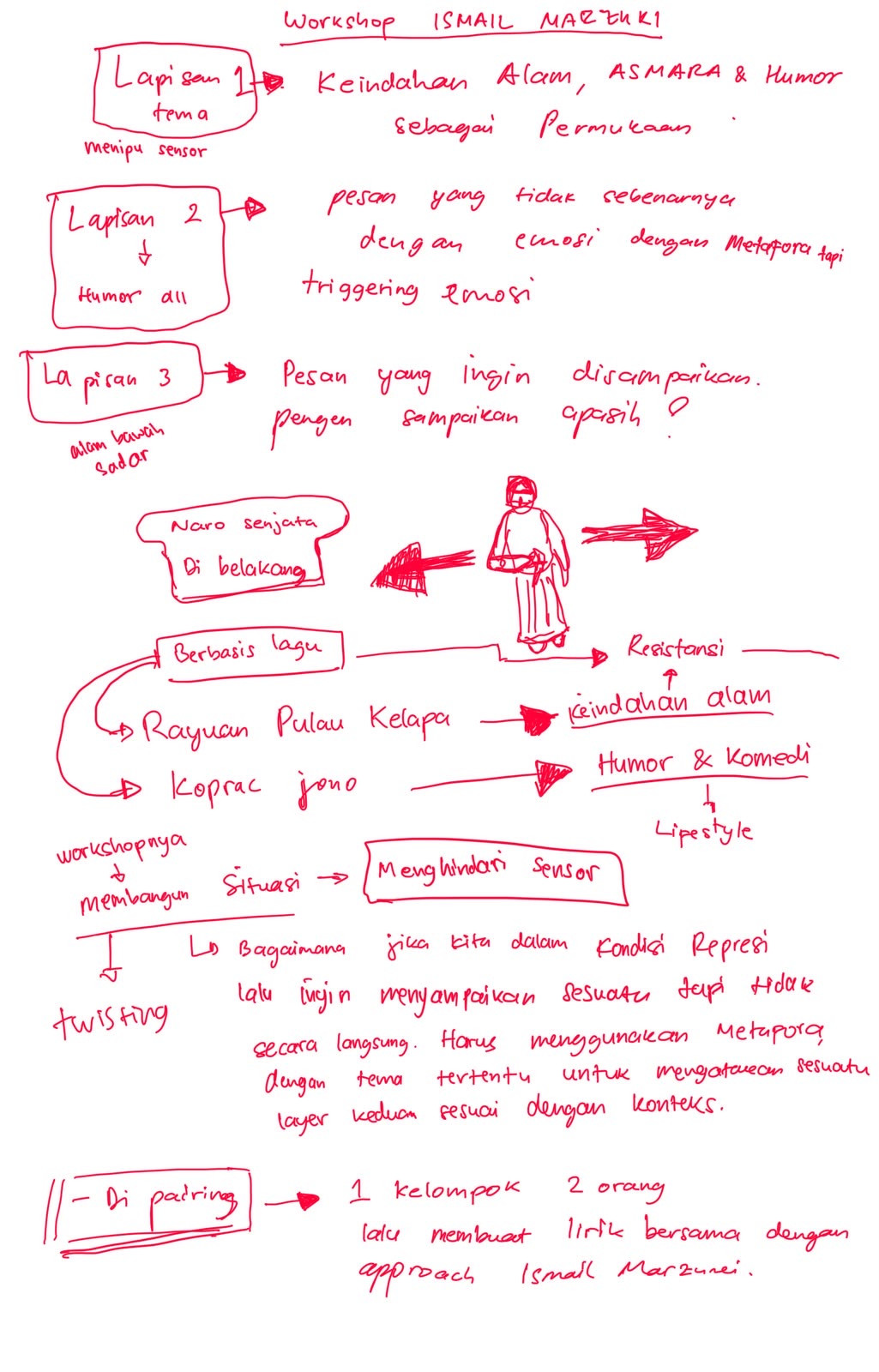
The Bang Maing Workshop: Writing Veiled Lyrics and Collective Solidarity is a collective laboratory designed to develop artistic strategies for embedding messages of resistance and social criticism within works that appear innocuous on the surface.
Inspired by the cultural approach and artistic process of Ismail Marzuki (nicknamed “Bang Maing”), who used natural beauty or humor as a mask to evade the authorities’ censorship, this workshop will assist participants in writing lyrics as a collaborative tool. Beginning with formulating a basic premise, building a shared word bank, and weaving veiled lyrics, participants will be guided to translate political and social concerns into poetic verses that are formally safe yet substantively sharp.
Berto Tukan is a member of the Jakarta-based art collective Gudskul Ekosistem. He is a writer and independent researcher. His latest books include Bercermin pada yang Sudah: Kumpulan Esai Budaya dan Seni (Reflecting on the Past: A Collection of Essays on Culture and Art, 2025) and Pada Tengah Malam Peradaban: Walter Benjamin tentang Seni dan Sejarah (At Midnight of Civilization: Walter Benjamin on Art and History, 2026).
JJ Adibrata studied visual art pedagogy at Jakarta State University, graduating in 2002. In 2006 he cofounded Serrum, a Jakarta-based art collective focused on art and pedagogy studies. He works as a designer, artist, creative consultant, and educator, and he was also involved in the Jakarta Biennale’s public education program in 2015 and 2017. His range of artistic practices includes physical-to-digital interactivity experiences, art pedagogy, blockchain, gamification, and publishing. He is currently an academic coordinator for Gudskul: Contemporary Art Collective and Ecosystem Studies. He is in charge of developing Gudskul’s online platform temujalar.art.
Moch Hasrul is a media artist and lecturer based in Jakarta, Indonesia. He is currently serving as the director of Serrum, an organization focused on art education, while also teaching in the Visual Communication Design program at Kalbis University. He is one of the founders of GudRnD, an experimental group focusing on engineering and trial-and-error methods in the development of alternative knowledge in the fields of plastic recycling, electronics, and mechanics. In his artistic practice, he explores computational devices, mechanics, electronics, and plastic recycling, combining technology and social issues to reflect contemporary sociopolitical phenomena.
Paola Pietronave is a curator, artist, mediator, and cofounder of several collaborative projects and collectives. She is currently conducting research for her PhD (Accademia Albertina di Belle Arti di Torino / Kalbis University) on the development of organizational forms involving the Lumbung method. In 2021 she published La condizione italiana contemporanea: Lavoratori dell’Arte 2009–2011 (The Contemporary Italian Situation: Art Workers 2009–2011) for the book series la centrale edizioni.
Gudskul: Collective and Contemporary Art Ecosystem Studies is an educational platform formed by three Jakarta-based collectives—ruangrupa, Serrum, and Grafis Huru Hara—which has been engaging in collective practice in the contemporary art scene since the early 2000s. In 2015 they formed the Gudang Sarinah Ekoksistem, with values emerging from the collective process: equity, sharing, solidarity, friendship, and togetherness. Learning from this working experience, in 2018 Gudskul transformed into a knowledge-sharing platform to spread the élan of art-cultural work among the public. Gudskul is a dynamic ecosystem that believes in sharing and working together as fundamental elements in developing Indonesian contemporary art and culture. They aspire to promote initiators who put local needs as their highest consideration while at the same time contributing and holding crucial roles internationally. Gudskul also houses a multitude of collectives with differing practices and artistic mediums.
This project is supported by the Italian Council (15th Edition, 2026), a program of the Directorate General for Contemporary Creativity of the Italian Ministry of Culture aimed at fostering the presence and awareness of Italian contemporary art abroad.